
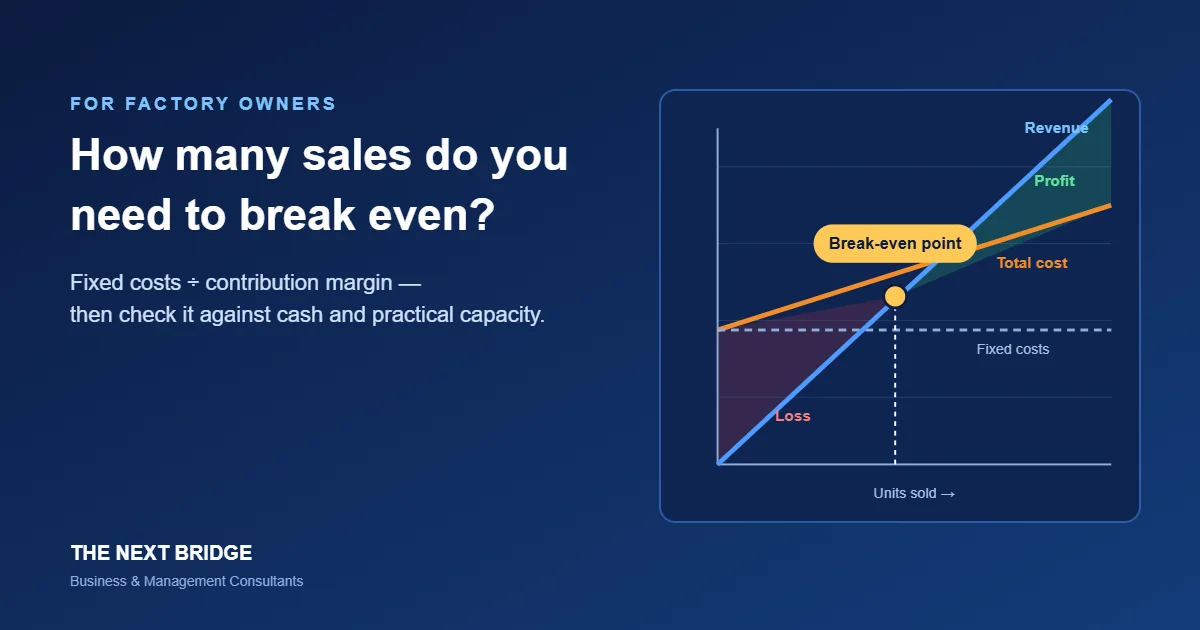
A factory can look busy from the outside and still lose money on every shift. Machines run, trucks load and invoices go out. The real question is: how many units do you have to sell before the first dollar of true profit appears?
That number is your break-even point. Most factory owners know it exists, but few calculate it the way a capital-heavy business really needs it. Below is the basic formula. Then come the layers that matter when you have heavy equipment, a term loan and a fixed monthly floor of costs.
The formula: fixed costs divided by contribution margin
Break-even is the point where total revenue exactly equals total costs. At this point there is no profit and no loss.
The standard way to calculate it involves two steps:
- Contribution margin per unit = Selling price per unit – Variable cost per unit
- Break-even units = Total fixed costs ÷ Contribution margin per unit
To get the break-even in sales value instead of units, divide total fixed costs by the contribution margin ratio. That ratio is the contribution margin divided by the selling price.
The only real work is separating your costs correctly:
- Variable costs rise and fall with output: raw materials, packaging, production power and piece-rate labor.
- Fixed costs stay the same whether you make 10 units or 10,000: rent, salaried staff, insurance, loan repayments and minimum facility charges.
A simple worked example
Take the numbers from a small-business teaching model (Small Business Finance Toolkit):
- Fixed costs: $3,000 per month
- Selling price: $50 per unit
- Variable cost: $30 per unit
Contribution margin is $50 – $30 = $20 per unit. Break-even is $3,000 ÷ $20 = 150 units, or $7,500 in revenue. At 150 units revenue equals costs. Every unit after that adds $20 to profit.
The same math works for a cafe with $1,000 of monthly fixed costs, a $10 item price and $6 of variable costs. The contribution is $4, so break-even is 250 sales, and sale number 251 is the first to produce profit.
The formula is simple. But a factory owner who stops here will usually underestimate the real number.
Why factories need more than the formula
In a cafe you can renegotiate a vendor contract or pause software subscriptions during a slow month. In a plant—packaging, plastics, pipe mills, food processing—there is a chunk of your cost structure that does not change when sales soften. Usually that floor includes:
- Debt servicing on machinery and civil work
- Minimum utility demand charges every month regardless of actual energy consumption (in India, for example, utility companies charge fixed demand rates based on contracted capacity)
- Technical, supervisory and administrative staff
- Compliance, insurance and preventive maintenance
The bigger that floor, the more units you have to ship before you see a single dollar of net income. That is operating leverage in action. It works brilliantly above break-even, but it punishes you quickly below it.
Accounting break-even vs cash break-even
This distinction causes more trouble than almost any other.
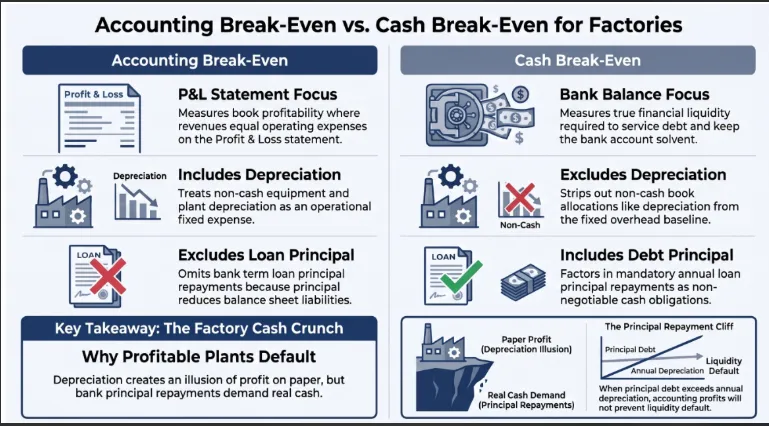
Accounting break-even asks when your profit-and-loss statement shows zero profit. Fixed costs here include depreciation, a non-cash book entry spread over the life of the machine.
Cash break-even asks when your bank account can pay everything it must pay. Depreciation drops out because no cash leaves the account. Loan principal repayments come in, because you must pay them in cash even though they never appear as an expense on the P&L (only interest does).
A simple way to write it:
- Accounting break-even units = (Fixed overheads incl. depreciation) ÷ Contribution margin
- Cash break-even units = (Cash fixed overheads + annual loan principal) ÷ Contribution margin
If your annual principal repayment is higher than your depreciation, your cash break-even is higher than your accounting break-even. That gap is where healthy-looking factories run out of cash, especially after grace periods or loan moratoriums end and principal payments kick in. (Your accountant can adjust the figures for tax and interest treatments.)
Nameplate capacity vs practical capacity
Owners often express break-even as a percentage of capacity, and the machine supplier’s brochure becomes the denominator. That is risky. Nameplate capacity assumes the equipment runs without interruption at full speed with no setups, no scrap and no waiting for material.
Practical capacity is what you can realistically produce after maintenance, changeovers, shift gaps and, above all, the bottleneck. If your printing machine does 1,000 units an hour but the curing line does 700, your plant makes 700.
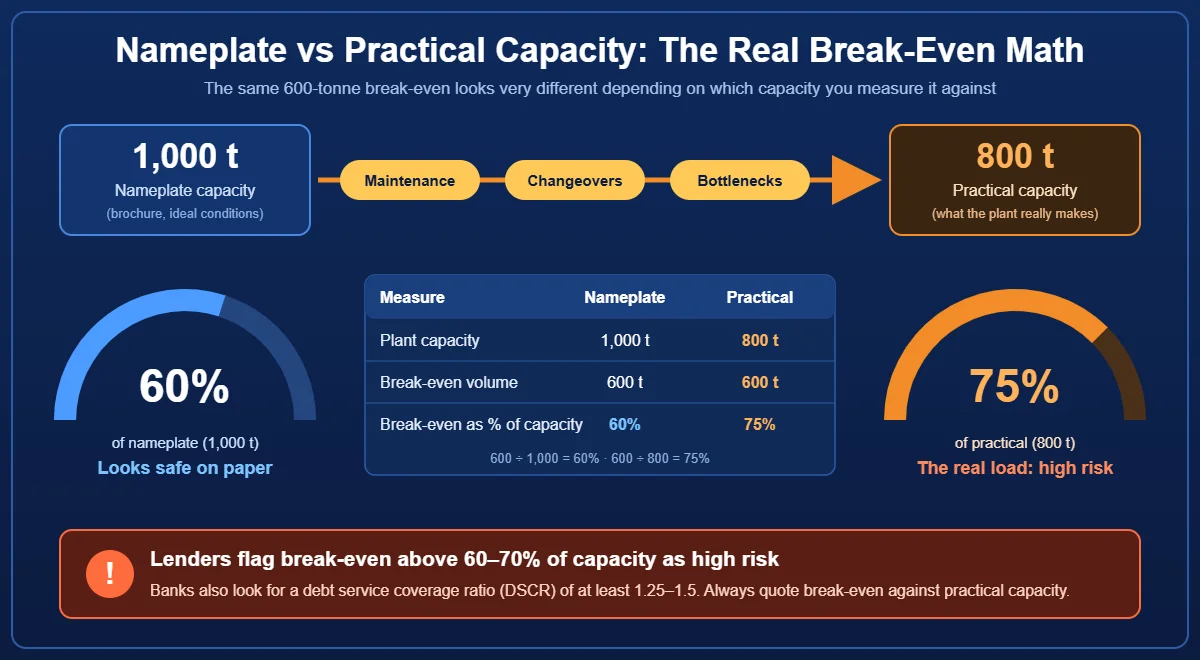
A quick illustration: a plant with 1,000 tonnes of nameplate capacity and 800 tonnes of practical capacity needs 600 tonnes to break even. Against nameplate that sounds like 60%. Against what the plant can actually do, it is 75%. Standard industrial cost accounting principles define capacity along these exact lines.
What lenders look at
Banks do not finance a project to reach zero profit. Many appraisals look at break-even as a share of capacity and at the debt service coverage ratio (DSCR). Commercial lenders and industrial development banks typically flag a break-even above 60–70% of installed capacity as high risk, and they generally look for a DSCR of at least 1.25 to 1.5.
Compare that with industry benchmarks: across global manufacturing economies, average industrial capacity utilisation typically hovers around 75%–80%.
Costs that quietly push the line up
- Price cuts. In the example, a 10% cut takes the price to $45 and the contribution to $15. Break-even moves from 150 to 200 units—33% more sales just to stand still.
- Variable costs that are not constant. Overtime, rush freight and running inefficient machines can raise unit cost at higher output.
- Scrap and ramp-up yield. More waste per unit means a thinner margin.
- Working capital. A sale is not cash until the customer pays. Interest on funding that gap adds to your fixed burden.
- Power treated as variable. Minimum demand charges act like fixed costs.
- Unplanned downtime. Idle machines still carry payroll and overheads.
A step-by-step way to find your number
- Split costs by behaviour, not by ledger heading. List what changes with output and what does not.
- Establish capacity. Start with available hours, deduct maintenance and changeovers, find the bottleneck process and adjust for normal scrap.
- Calculate contribution margin per unit. For multiple products, use a weighted average based on your real sales mix.
- Compute both break-evens: accounting and cash.
- Express each as a percentage of practical capacity. Compare against lender expectations and the industry utilisation range.
- Stress-test. Try material up 10%, a power tariff increase, a 5% selling price drop or higher rejections. Watch how far the break-even moves.
Use the 5M lens to find the reasons behind the numbers: Man (productivity), Machine (downtime), Material (scrap), Method (changeovers, layout) and Money (collections). Each one moves either your margin or your volume.
FAQ
What is the break-even formula in one line?
Break-even units = total fixed costs ÷ (selling price per unit – variable cost per unit).
Is break-even the same as being safe?
No. It means zero profit. Safety comes from the margin between your break-even and your realistic volume, plus enough cash to cover loan repayments.
Why do I need a cash break-even if my accountant shows a profit?
Profit includes non-cash depreciation and excludes loan principal. Your bank account feels the opposite. A profitable P&L can still sit alongside a cash shortfall.
Should I measure break-even against machine capacity?
Measure it against practical capacity, not the supplier’s nameplate figure. The same volume looks much riskier against a lower denominator.
Next step
If you are planning a new plant, expanding a line, or preparing a project report for financing, run these numbers before committing capital. Book a free consultation with our team to review your cost structure, capacity assumptions and cash break-even.